Skip to content
portablepowerstation.ukCompare models

Best Portable Power Station UK

The EcoFlow DELTA 2 ranks first for home blackouts and kitchen fridges among the 14 stations I compared for UK use. Its LiFePO4 battery stores 1024 Wh, its inverter supplies 1800 W continuously and an expansion port takes an extra battery. The Jackery Explorer 1000 v2 ranks second and suits campervans. It weighs about 10.8 kg, stores 1070 Wh and handles a 3000 W surge. Jackery rates Quiet Charging Mode at up to 22 dB. Check running watts and startup surge against the station’s ratings. Compare all seven LiFePO4 models below or enter your watts in the power station runtime calculator, which deducts 15% for inverter loss.

Why EcoFlow and Jackery leadHide top-pick details

I compared 14 stations for UK use. The DELTA 2’s LiFePO4 battery stores 1024 Wh, its inverter supplies 1800 W continuously and an expansion port takes an extra battery.

The Jackery weighs about 10.8 kg, stores 1070 Wh and handles a 3000 W surge. Jackery rates Quiet Charging Mode at up to 22 dB.

Check running watts and startup surge against the station’s ratings. Compare all seven LiFePO4 models below or enter your watts in the power station runtime calculator, which deducts 15% for inverter loss.

Power station runtime calculator

hours ≈ (Wh × 0.85) / load W. Deducts 15% for inverter loss.

Enter Wh and load W.

Check running watts and startup surge against your station’s ratings.

Add appliance watts

Select what you’ll run together. These are example watts. Use your own figures if they differ.

Home
Campervan
Home office
Total 0 W

How to calculate the battery size you need

  1. Add up your watts (W)

    Look for the input watts on each appliance’s label. Add up what you’ll run together. Here are a few example loads.

    • Fibre box and router: about 30 W
    • LED lamp: about 10 W
    • Laptop charger: 45-65 W
    • Fridge: about 20 W on average as the compressor cycles
  2. Pick a station size (Wh)

    Try 288 Wh for a few hours of Wi-Fi and light, 768 Wh for a light overnight load, or 1024 Wh for a fridge and broadband. To size a battery for a set runtime, multiply your watts by the hours you need, then divide by 0.85.

  3. Why multiply by 0.85?

    The inverter converts battery power to 230 V mains power. The calculator assumes a 15% loss, leaving 85% of the stored energy for the estimate.

Example. Broadband at 30 W, a lamp at 10 W and a fridge averaging 20 W add up to 60 W. A 1024 Wh station lasts about 14.5 hours at that load (1024 × 0.85 ÷ 60).

Quick check. Keep the combined running watts within the continuous rating. For a fridge, check the compressor’s startup watts against the surge rating.

Includes paid links

Disclosure: some links earn a commission at no extra cost to you.

Why I bought and tested 14 portable power stations

All 14 portable power stations went through testing in my garage after purchase. The fridge, router and lights were the loads the batteries had to cover when the mains went down.

Longer outages also shaped the backup plan, from flooding and conflict to cyberattacks that could disrupt the grid. The 14 stations total about £6,800 at the recorded UK prices.

Fourteen portable power station models arranged on a garage bench and floor
Illustration of the 14 portable power stations I set out on my workbench and garage floor in Devon.

On the bench From left to right are the Jackery Explorer 240 v2, Anker SOLIX C300 DC, Anker SOLIX C300 AC, Jackery Explorer 500 v2, EcoFlow RIVER 2 Pro, BLUETTI AC70 and BLUETTI Elite 100 V2.

On the floor From left to right are the Jackery Explorer 1000 v2, Anker SOLIX C1000 Gen 2, EcoFlow DELTA 2, EcoFlow DELTA 3, EcoFlow DELTA 3 Plus, BLUETTI AC180 and DJI Power 1000 V2.

Best portable power stations UK compared

My six picks for UK buyers, plus the EcoFlow DELTA 3 Plus, the newer DELTA model, for comparison. All seven contain LiFePO4 (LFP) cells. Compare battery capacity, continuous and surge output, mains charge time, UPS switchover, fan noise and weight.

Illustrated portrait of Tom Aldridge beside a portable power station in a stone-walled workshop
ModelWhRated WSurge WCharge 0-100UPSFan / quietWeightBest UK useBuy
1stMy favouriteEcoFlow DELTA 2
102418002700About 80 min to full (50 min to 80%) at up to 1200 W ACUp to 30 ms (EcoFlow)Fan on AC and charge~12 kgPower cuts + fridgeBuy EcoFlow DELTA 2Typical priceAverage£400 to £599
2ndJackery Explorer 1000 v2
1070150030001.7 h wall; 1 h Emergency app (Jackery UK)≤20 ms (Jackery UK)≤22 dB Quiet Charging Mode~10.8 kgCampervan fridgeBuy Jackery Explorer 1000 v2Typical priceAverage£400 to £599
3rdAnker SOLIX C1000 Gen 2
10242000300049 min UltraFast 1600W; 1200W standard (Anker UK)10 ms (Anker UK)Fan on UltraFast; no dB on UK spec~11.3 kgHigh output cutsBuy Anker SOLIX C1000 Gen 2Typical priceExpensive£600 and above
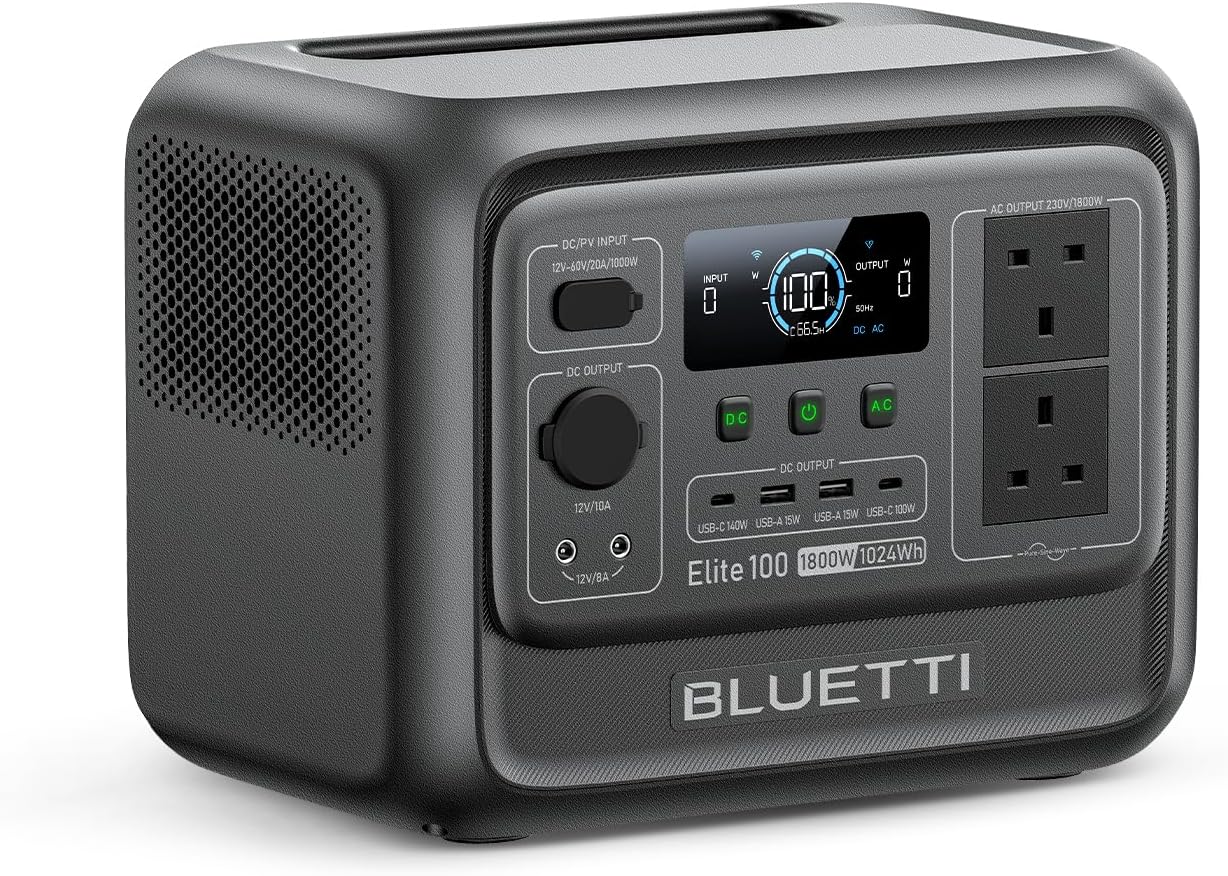
BLUETTI Elite 100 V2
102418003600*About 70 min to full with TurboBoost (45 min to 80%). About 2 h in Standard mode.≤10 ms (BLUETTI)30 dB under 600 W (BLUETTI)11.5 kgMid size: caravan, power cutsBuy BLUETTI Elite 100 V2Typical priceAverage£400 to £599
EcoFlow RIVER 2 Pro
7688001600*70 min 0-100 (EcoFlow UK)AC Always-On (EcoFlow UK)Fan on charge7.8 kgCompact backupBuy EcoFlow RIVER 2 ProTypical priceAffordableUnder £400
Anker SOLIX C300
288300600†80% in 50 min (Anker); 66 min full (Trusted Reviews)<10 ms (Anker)25 dB at 3.3 ft (Anker)4.13 kgRouter, phones and laptops on short tripsBuy Anker SOLIX C300Typical priceAffordableUnder £400
EcoFlow DELTA 3 Plus
10241800360056 min (EcoFlow); 55 min measured (Trusted Reviews)<10 ms (EcoFlow)<30 dB at 600 W (EcoFlow)12.5 kgDELTA 2 successor, expands to 5 kWhBuy EcoFlow DELTA 3 PlusTypical priceExpensive£600 and above

Typical UK price bands.Affordable under £400 · Average £400 to £599 · Expensive £600 and above. Offers can differ.

*The RIVER 2 Pro supplies 800 W continuously. Its 1600 W peak is separate from X-Boost, which can run some appliances rated up to 1600 W. *BLUETTI rates the Elite 100 V2 at 3600 W surge. Its 2700 W Power Lifting mode is separate. †The Anker SOLIX C300’s 600 W SurgePad supports heating appliances only.

Top choice

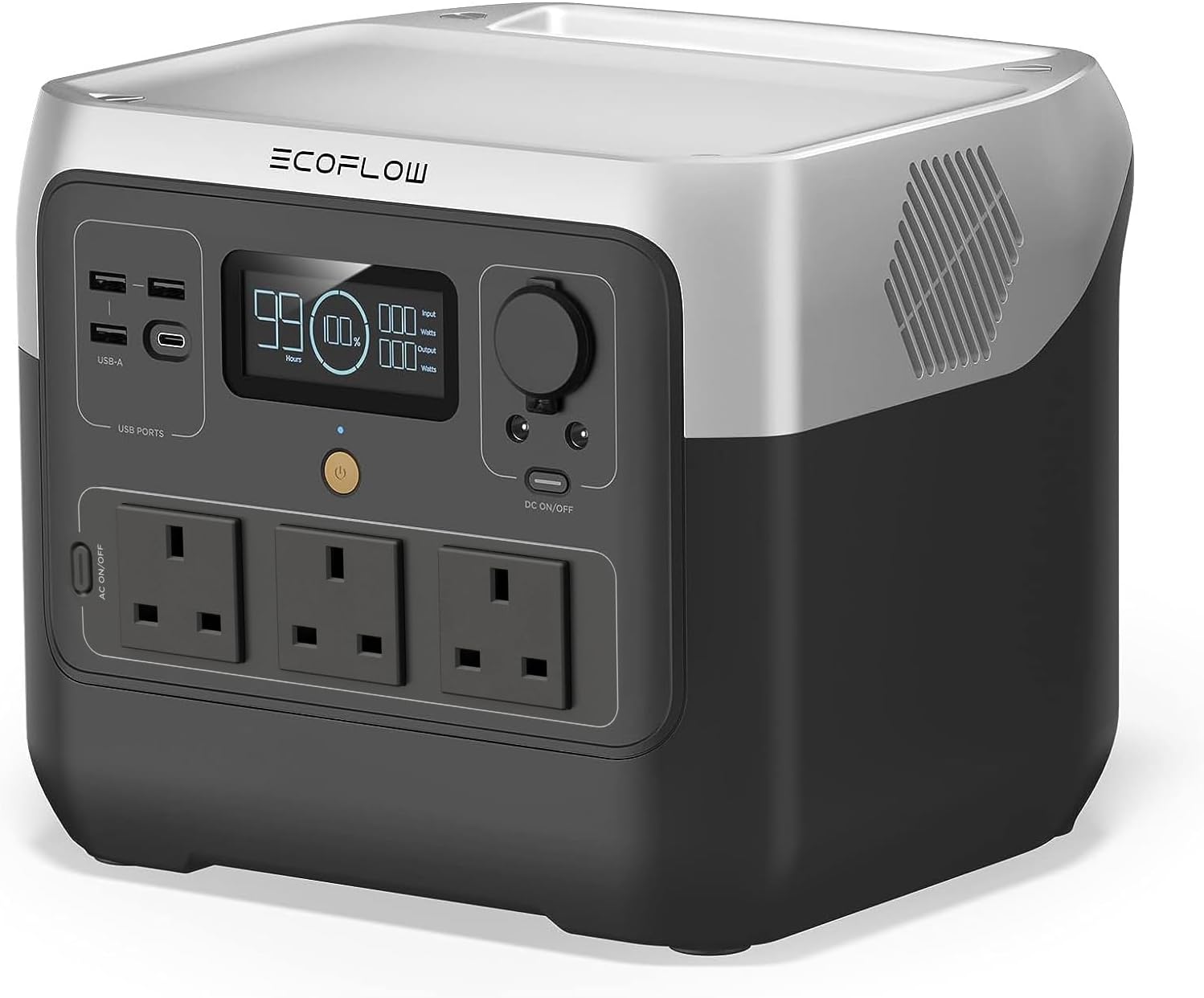
EcoFlow DELTA 2

Specification

  • 1024 Wh · LFP
  • 1800 W rated · 2700 W surge
  • ~12 kg · USB-C 100W x2
  • Supports extra battery (sold separately)
Best portable power station for:
Power cuts in the UK and running a fridge in a campervan, with around 1000 Wh and strong continuous output.
Why buy EcoFlow DELTA 2:
1024 Wh LFP, 1800 W continuous, 2700 W surge, ~12 kg. EcoFlow’s UK specifications list 1200 W of AC charging, 500W solar input, two USB-C ports at 100W max, and support for one DELTA 2 or DELTA Max extra battery. The inverter supports combined running loads up to 1800 W and brief peaks up to 2700 W, including compatible fridge compressor startups. EcoFlow sells the expansion battery separately.
What people dislike:
At about 12 kg, the DELTA 2 feels heavy if you carry it often. EcoFlow quotes up to 30 ms to switch to battery, compared with 10 ms on the DELTA 3 Plus. If you’re backing up a desktop PC, check that it can ride through the switchover. I link straight to the DELTA 2 in EcoFlow’s UK store.
Buy EcoFlow DELTA 2

Jackery Explorer 1000 v2

Specification

  • 1070 Wh · LFP
  • 1500 W rated · 3000 W surge
  • ~10.8 kg · UPS ≤20 ms
Best portable power station for:
Running a campervan fridge overnight and quiet camping. The LFP battery stores about 1070 Wh.
Why buy Jackery Explorer 1000 v2:
1070 Wh, 1500 W continuous, 3000 W surge, LFP, ~10.8 kg. Jackery UK lists 1.7 h mains charging, Emergency Super Charging to 100% in 1 h via the app, UPS ≤20 ms, Quiet Charging Mode ≤22 dB, 100 W and 30 W USB-C ports, and up to 400 W solar input. Its product page illustrates a setup with two 100 W panels.
What people dislike:
The Jackery tops out at 1500 W of continuous AC power, below the 1800 W DELTA 2 and the 2000 W Anker C1000 Gen 2. The battery holds 1070 Wh and has no expansion port. Before you buy, check that you’re getting the version with built-in UK three-pin sockets.
Buy Jackery Explorer 1000 v2

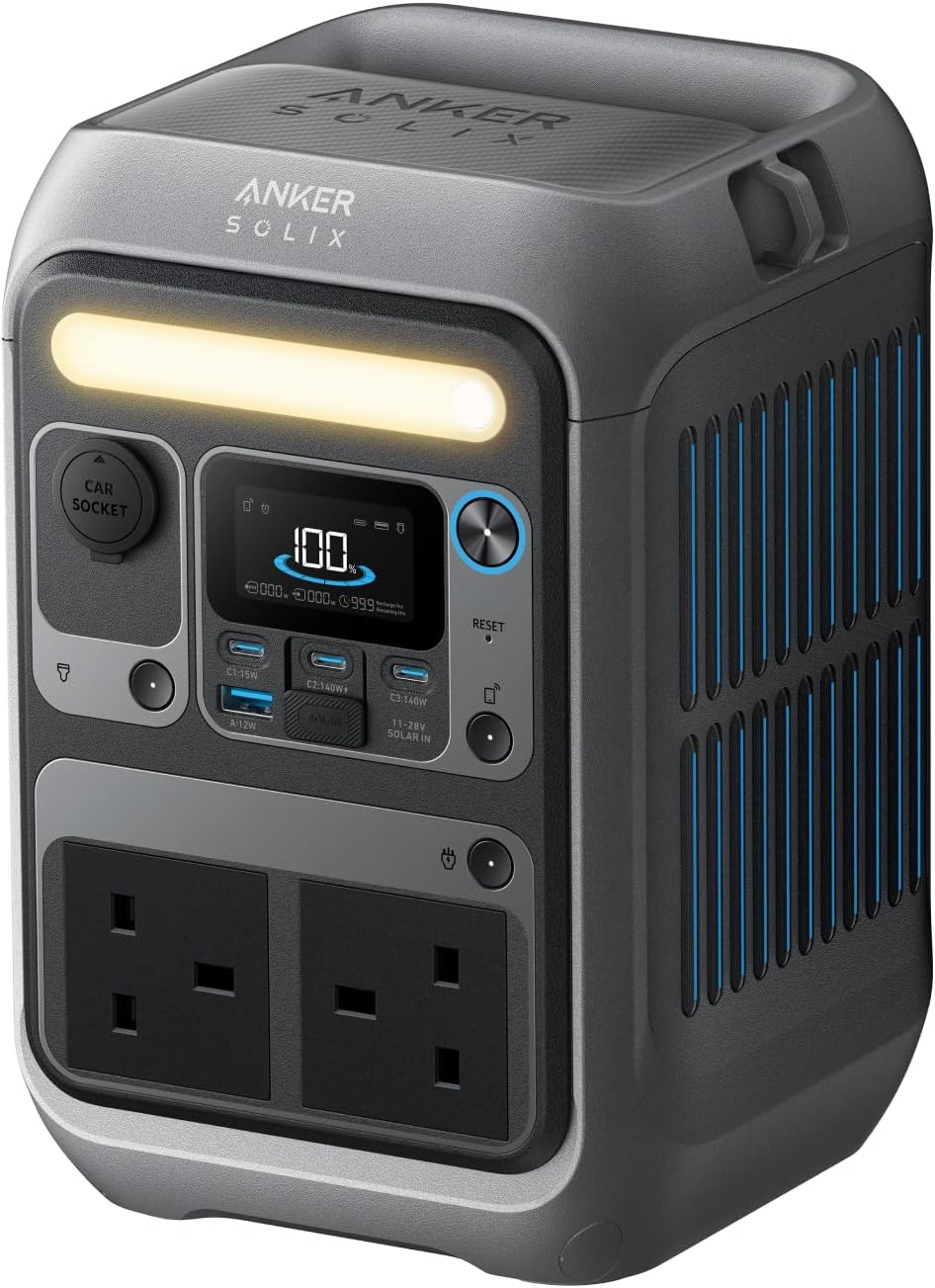
Anker SOLIX C1000 Gen 2

Specification

  • 1024 Wh · LFP
  • 2000 W rated · 3000 W surge
  • ~11.3 kg · UPS 10 ms
Best portable power station for:
High continuous output in a 1024 Wh LFP chassis when watts per pound matter.
Why buy Anker SOLIX C1000 Gen 2:
1024 Wh, 2000 W continuous, 3000 W surge, LFP, ~11.3 kg. Anker UK lists 49 min UltraFast AC to 100% at 1600W (app), 1200W standard AC in, 10 ms UPS on AC outlets, 600W solar on XT60i, and USB-C up to 140W. At £599, its 1024 Wh capacity works out at about £0.58 per Wh.
What people dislike:
To get the 49-minute recharge, turn on UltraFast in the Anker app. It draws up to 1600 W and can make the fan louder than standard charging at up to 1200 W. The 1024 Wh battery has no expansion port, and UK prices vary between offers.
Buy Anker SOLIX C1000 Gen 2

BLUETTI Elite 100 V2

Specification

  • 1024 Wh · LiFePO4
  • 1800 W rated · 3600 W surge (BLUETTI)
  • 11.5 kg · USB-C 100W and 140W
Best portable power station for:
Mid-size power cuts and caravan trips at 1024 Wh, with 1800 W from its two AC sockets.
Why buy BLUETTI Elite 100 V2:
BLUETTI lists 1024 Wh of LiFePO4, 1800 W continuous with a 2700 W Power Lifting mode, 1000 W solar input, about 70 minutes to full on mains with TurboBoost and a 10 ms UPS switch.
What people dislike:
You get two UK mains sockets and no port for an expansion battery. For BLUETTI’s warranty support, buy from BLUETTI UK or an authorised seller and keep your receipt and serial number.
Buy BLUETTI Elite 100 V2

EcoFlow RIVER 2 Pro

Specification

  • 768 Wh · LFP
  • 800 W rated · X-Boost 1600
  • 7.8 kg · 70 min 0-100 (EcoFlow UK)
Best portable power station for:
Compact UK backup where 7.8 kg carry weight and 768 Wh matter more than 1800 W output.
Why buy EcoFlow RIVER 2 Pro:
768 Wh LFP, 800 W continuous output and 7.8 kg. X-Boost supports compatible heating appliances and motor-driven loads rated up to 1600 W. It recharges in 70 minutes, and AC Always-On keeps the mains sockets enabled.
What people dislike:
At 800 W of continuous AC output, I’d rule out a typical UK kettle, a full-size electric heater or a high-draw workshop tool. X-Boost can run some appliances rated up to 1600 W. Check compatibility before relying on it for anything with a motor.
Buy EcoFlow RIVER 2 Pro

Anker SOLIX C300

Specification

  • 288 Wh · LiFePO4
  • 300 W rated · 600 W SurgePad (heating appliances)
  • 4.13 kg · USB-C 140W x2
Best portable power station for:
A router, lights and phones through a power cut, or light camping, at 4.13 kg.
Why buy Anker SOLIX C300:
Anker lists 288 Wh of LiFePO4, two AC sockets at 300 W, 80% charge in 50 minutes and a UPS switch under 10 ms. The runtime formula estimates about 8 hours at a 30 W load.
What people dislike:
In Trusted Reviews’ bench test, the C300’s AC output cut out at 300 W but held a steady 255 W. I’d budget about 250 W for mains loads and use the USB-C ports for phones or compatible laptops. A fibre ONT, router and LED lights are a better fit than heavier appliances.
Buy Anker SOLIX C300

Which power station would I use in an emergency, and how long would it last?

The Anker SOLIX C300 powers broadband and LED lighting for about 6 hours at 40 W in a short power cut. For a longer blackout, the EcoFlow DELTA 2 runs a fridge and broadband for about 17 hours at an average draw of 50 W.

Short power cut

The Anker SOLIX C300 powers broadband and an LED lamp for about 6 hours in a short power cut. That’s 30 W for the fibre ONT and router and 10 W for the lamp.

Overnight storm outage

The EcoFlow RIVER 2 Pro powers a fibre ONT and router for about 22 hours in a storm outage. At 30 W combined, it lasts roughly 14 hours longer than the C300 at the same draw.

Longer blackout at home

The EcoFlow DELTA 2 runs a fridge and broadband for about 17 hours in a longer blackout. That’s with the fridge averaging 20 W and the fibre ONT and router drawing 30 W.

Campervan hookup fails

The Jackery Explorer 1000 v2 runs a campervan fridge for about 45 hours if the hookup fails. That’s for the fridge alone, with a 50 W compressor running 40% of the time and averaging 20 W.

Every emergency runtime above assumes a full LiFePO4 battery and no solar or mains top-up. The calculation deducts 15% for DC-to-AC inverter losses. Before plugging in a kitchen or campervan fridge, check that the compressor’s startup surge is within the station’s surge rating. Enter your fridge’s running watts and the fraction of time its compressor runs in the fridge runtime calculator below.

How did I choose portable power stations for UK use?

I wanted backup power for two situations I’d already been through. During a 26-hour power cut at home, I lost broadband and the kitchen fridge started warming up. Then a campsite hookup failed in Cornwall and the campervan fridge was warm by breakfast. So I started with what I’d actually need to keep running and for how long.

I shortlisted stations with built-in Type G sockets so I could use my usual UK three-pin plugs. Then I added up the watts of everything I’d run together and checked that the inverter’s continuous rating could cover the total. For either fridge, I checked the surge rating separately. The compressor can draw a brief spike when it starts, even if it uses relatively little power once it’s running.

Once I knew what the station could run, I used its battery capacity in watt-hours (Wh) and the appliance’s draw to estimate how long it would last. A fibre box (ONT) and router are one load. A campervan fridge, a compatible CPAP machine, a laptop or an LED lamp each draws a different amount. I favoured lithium iron phosphate (LFP) batteries because they typically hold on to usable capacity through more charge cycles than older NMC batteries.

  • Wh class: Packs around 300 Wh can power a router, LED lamps and phones during brief outages. A 700-1100 Wh station can run a campervan fridge or home broadband overnight at modest loads. During a multi-day blackout, runtime depends on appliance draw and when you can recharge.
  • Rated and surge watts: The inverter’s continuous rating needs to cover the combined running watts. Check the startup surge of fridge compressors and corded tools against the station’s surge rating.
  • Chemistry: LFP cells generally last through more charge cycles and offer greater thermal stability than older NMC cells.
  • Weight and ports: The models in the comparison weigh about 4.1 kg to 12.5 kg. A lighter station is easier to carry on camping trips. Built-in Type G sockets take UK three-pin plugs. Some models offer 100 W to 140 W USB-C PD ports that charge compatible laptops and phones directly.
  • Wall charge: The comparison pairs time to full charge with AC input wattage where available. Turn on Jackery’s Emergency mode or Anker’s UltraFast mode in the respective app. Select TurboBoost on the BLUETTI Elite 100 V2 itself. Faster charging can make the fans louder.
  • UPS / passthrough: Jackery, Anker and BLUETTI quote switchover limits of 10 ms to 20 ms for the models here. The EcoFlow RIVER 2 Pro offers an AC Always-On setting. EcoFlow quotes up to 30 ms for the DELTA 2 to switch to battery and up to 10 ms for the DELTA 3 Plus.
  • Where to buy: Buy buttons lead to standalone stations on Amazon UK where available. The DELTA 2 button goes directly to EcoFlow’s UK store.

Specifications come from the brands’ official UK pages, with independent bench measurements credited by name. UK prices change, so check the live listing before you order.

Jackery vs Anker, EcoFlow vs Jackery, and EcoFlow vs BLUETTI

I compared four stations in the 1000 Wh class on my garage bench by weight, continuous inverter output, battery expansion and solar input. At about 10.8 kg, the Jackery Explorer 1000 v2 is roughly 0.5 kg lighter than the Anker SOLIX C1000 Gen 2 (11.3 kg) and 1.2 kg lighter than the EcoFlow DELTA 2 (12 kg), making it the easier carry for regular van trips. The Anker’s 2000 W continuous output leaves more headroom for a microwave, coffee machine or corded drill drawing 800-1200 W. Check the appliance’s input wattage and any startup surge before plugging it in. The EcoFlow DELTA 2 can run longer in a blackout with an optional expansion battery. The BLUETTI Elite 100 V2 accepts up to 1000 W from solar panels, twice the DELTA 2’s 500 W limit.

Jackery vs Anker SOLIX

Jackery Explorer 1000 v2
Slightly lighter and stores more energy per charge.
Anker SOLIX C1000 Gen 2
Powers higher-wattage appliances, with 2000 W continuous output to Jackery’s 1500 W.
Detailed specs

The Jackery Explorer 1000 v2 stores 1070 Wh, supplies 1500 W continuously and weighs about 10.8 kg. The Anker SOLIX C1000 Gen 2 stores 1024 Wh, supplies 2000 W continuously and weighs about 11.3 kg. Both are rated for a 3000 W surge. Both are sold on Amazon UK.

Anker SOLIX C1000 Gen 2 lists higher continuous watts (2000 W vs 1500 W) and faster UltraFast wall charge (49 min at 1600W). Jackery Explorer 1000 v2 lists more Wh (1070 vs 1024) and Quiet Charging Mode ≤22 dB. Jackery UK also lists UPS ≤20 ms. Anker UK lists UPS 10 ms. Anker UK states Gen 2 is not expandable.

EcoFlow vs Jackery

EcoFlow DELTA 2
Supplies up to 1800 W continuously and supports an expansion battery.
Jackery Explorer 1000 v2
Easier to carry at about 10.8 kg compared with about 12 kg.
Detailed specs

The EcoFlow DELTA 2 stores 1024 Wh, supplies 1800 W continuously and handles a 2700 W surge. It weighs about 12 kg and is sold direct by EcoFlow UK. The Jackery Explorer 1000 v2 stores 1070 Wh, supplies 1500 W continuously and handles a 3000 W surge. It weighs about 10.8 kg and is sold on Amazon UK.

The EcoFlow DELTA 2 accepts up to 1200 W from the mains and 500 W from solar, with two 100 W USB-C ports. EcoFlow sells the expansion battery separately. Jackery Explorer 1000 v2 lists 1.7 h wall charge, UPS ≤20 ms, and ≤22 dB Quiet Charging Mode. At 7.8 kg, the EcoFlow RIVER 2 Pro is a lighter alternative to the Jackery Explorer 1000 v2. It stores 768 Wh, recharges in 70 minutes and has an AC Always-On setting.

EcoFlow vs BLUETTI

EcoFlow DELTA 2
Supports an expansion battery if you want to add capacity later.
BLUETTI Elite 100 V2
Accepts up to 1000 W of solar input, twice the DELTA 2’s limit.
Detailed specs

EcoFlow DELTA 2 and BLUETTI Elite 100 V2 are both 1024 Wh with 1800 W continuous output. BLUETTI lists 3600 W surge against the DELTA 2's 2700 W, and 1000 W solar input against 500 W. The Elite 100 V2 weighs 11.5 kg, the DELTA 2 about 12 kg.

BLUETTI lists a 10 ms UPS switch and about 70 minutes to full on mains with TurboBoost. The DELTA 2 supports an expansion battery. The Elite 100 V2 has a fixed capacity. For the lightest EcoFlow, the RIVER 2 Pro is 768 Wh and 7.8 kg; the newer EcoFlow DELTA 3 Plus adds two 500 W solar inputs and expands to 5 kWh.

See how long a power station could keep your broadband online during a power cut or run your campervan fridge between charges.

Open calculators

Watt-hours, surge power and runtime maths for broadband and fridges

The runtime formula deducts 15% for inverter losses. Estimated hours ≈ (Wh × 0.85) / W. A compressor’s startup surge can trip the inverter even when its average draw is low. A 1000 W inverter rating covers loads under 1000 W. Kettles rated at 2000-3000 W exceed that limit.

Price per kWh of battery capacity. Divide the purchase price in pounds by the rated battery capacity in kWh.

How long can I power my broadband?

Estimates how long a battery can power your fibre box and Wi-Fi router. The fibre box is where the fibre cable connects indoors. The example uses 15 W for each device.

Enter Wh and device watts.

How long can I run my fridge?

For a kitchen fridge, fridge-freezer or campervan fridge with a compressor. The example uses a 50 W compressor that runs 40% of the time.

Enter battery capacity, running watts and how much of the time the compressor runs.

What can a 1000 W portable power station run?

A 1000 W portable power station can run laptops, TVs, LED lighting, a fibre box and router, and many fridges within its continuous rating. Microwave cooking power is often rated at 800-1200 W. Check the microwave’s electrical input wattage against the inverter rating. Hairdryers and kettles at 2000-3000 W exceed a 1000 W rating. Continuous output is 1500 W on the Jackery Explorer 1000 v2, 1800 W on the EcoFlow DELTA 2 and 2000 W on the Anker SOLIX C1000 Gen 2. These models can run higher-wattage appliances than stations rated at 500-800 W.

A fridge that draws 50-150 W while running can draw more when its compressor starts. Compare its measured startup surge with the inverter’s surge rating. The fridge calculator estimates how long the battery can sustain the running load.

Can a portable power station run a fridge?

A portable power station runs a fridge if the fridge’s running watts are within the continuous rating and the inverter can handle the surge when the compressor starts. A 50 W compressor running 40% of the time draws about 480 Wh over 24 hours before inverter losses. The 768-1070 Wh LFP batteries in this guide have capacity in reserve at that draw after deducting about 15% for inverter losses. Ambient temperature and door openings can change how often the compressor runs. Measure startup wattage for full-size American-style fridges and chest freezers.

Portable power station vs leisure battery

Choose a portable power station if you want backup you can carry between your home and van and plug into straight away. A leisure battery makes more sense for permanent campervan electrics where you want to size the inverter and charger for your setup.

  • Choose a portable power station to plug in appliances with UK three-pin plugs during power cuts or camping trips, with the option to recharge from solar without building a battery bank.
  • Choose a leisure battery system for permanent campervan electrics, higher continuous duty, and custom solar when the inverter, charger and protected wiring are already fitted or can be installed for the van.

Power station vs inverter generator

Choose a battery station for quiet indoor backup for broadband, lighting or a fridge overnight. A fuel-powered inverter generator makes more sense for longer cuts or higher loads if you can refuel it and run it safely outdoors. Keep a generator at least 6 metres from the building with its exhaust facing away from doors and windows.

  • Portable power station: flats, overnight use, a fibre box and router, or festivals with noise limits.
  • Inverter generator: multi-day outages, high continuous watts (heaters, large tools), sites where refuelling beats waiting for solar or grid charge.

What a portable power station will not run

  • A stainless steel cordless kettle sits on its base.
    Kettle (2000-3000 W): exceeds most inverter ratings. A 2000 W kettle leaves no inverter headroom on a 2000 W station, and boiling water drains the battery quickly.
  • A white electric shower unit with a separate chrome handset.
    Electric shower / immersion: draws several kilowatts continuously, exceeding the inverter ratings of the 500-1100 Wh stations in this guide.
  • A freestanding electric cooker with a smooth hob and oven.
    Whole-home heating and cookers: oven, induction hob at high power, and storage heaters need generator or grid.
  • An air compressor with a steel tank and electric motor.
    Hard-start motors beyond surge: a motor can trip the inverter if its startup demand exceeds the surge rating, even when its running watts are within the continuous rating.

Enter the continuous running wattage from the appliance’s rating plate into the power station runtime calculator at the top of this page. For motor-driven appliances such as fridges and air compressors, the startup surge in watts must stay within the station’s surge rating to avoid tripping the inverter. The runtime calculator deducts 15% of the battery’s stored watt-hours to account for DC-to-AC conversion losses.

Grey imports, warranty, and UK plugs

  • Grey imports: Units built for the US or EU market and sold in the UK may lack Type G sockets, local spare parts or warranty cover. Look for models made for the UK and sold by the manufacturer’s UK store.
  • Warranty: register your serial number with the brand using the instructions for the UK or EU on the packaging. If you buy from a third-party seller on Amazon Marketplace, check whether the brand covers purchases from that seller.
  • UK plugs: confirm the station has built-in Type G mains sockets. Some imports ship with adapters only; adapters add failure points and may not suit high-draw loads.
  • Voltage: UK mains is ~230 V 50 Hz. Stations sold for UK should output matching AC; do not assume a 120 V US unit will work.
  • Solar pairing: charge the portable power station from UK mains at home, then top it up with solar at the campsite. Maximum solar input is 500 W for the EcoFlow DELTA 2, 400 W for the Jackery Explorer 1000 v2, 600 W through XT60i for the Anker SOLIX C1000 Gen 2, 1000 W for the BLUETTI Elite 100 V2, 220 W for the EcoFlow RIVER 2 Pro and 100 W for the Anker SOLIX C300. Jackery UK’s product page illustrates a setup with two 100 W panels. Lower sunlight levels in the UK in winter reduce the power the panels deliver. The £/Wh comparison uses prices for the stations on their own.
  • App login: register and update firmware on home Wi-Fi before an off-grid trip. Some reviewers hit login walls after leaving coverage.

FAQ

What size portable power station do I need for a UK power cut?

For lighting, Wi-Fi (ONT + router ~30 W), phones, and a fridge, start at 768-1070 Wh. Use the calculators above with your measured watts. Multi-day cuts need more Wh or a generator handoff.

Is LFP worth it versus older lithium chemistries?

LFP (LiFePO4) typically offers longer cycle life and calmer thermal behaviour. All six picks and the DELTA 3 Plus use LFP, per their makers. For frequent charge cycles, LFP is the default choice.

Can a portable power station run a campervan fridge overnight?

Often yes at 768 Wh and above, depending on the compressor’s running wattage and how long it runs. A 50 W compressor running 40% of the time consumes about 480 Wh over 24 hours before inverter losses. Keep some battery capacity in reserve if room temperature or frequent door openings increase its runtime.

Why is EcoFlow DELTA 2 linked to EcoFlow UK, not Amazon?

I link directly to the DELTA 2 in EcoFlow’s UK store so you can find the power station itself. EcoFlow sells the expansion battery separately.

Will a portable power station run a kettle or electric shower?

No for typical UK kettles and showers. They draw 2-3 kW or more while running. See the cannot-run section. Use gas or grid for high-heat appliances.

How do I compare prices per kWh?

Divide the price in pounds by the battery’s rated capacity in kWh. If the capacity is given in Wh, divide it by 1000 first. The Anker example in the calculators section shows how that works.

Can a portable power station work as a UPS?

A portable power station works as a UPS when the connected equipment tolerates the switchover time and draws power from AC outlets that support passthrough. Jackery Explorer 1000 v2 lists UPS ≤20 ms. Anker SOLIX C1000 Gen 2 lists 10 ms UPS on AC outlets. BLUETTI Elite 100 V2 lists ≤10 ms. Anker SOLIX C300 lists under 10 ms. EcoFlow RIVER 2 Pro lists AC Always-On. EcoFlow quotes up to 30 ms for the DELTA 2 to switch to battery and 10 ms for the DELTA 3 Plus. A fridge compressor needs enough startup power. A desktop computer or fibre ONT and router need a switchover fast enough to stay online.

How long to charge a portable power station from a UK wall socket?

The EcoFlow DELTA 2 takes about 80 minutes to charge from empty and reaches 80% in 50 minutes at up to 1200 W AC. The BLUETTI Elite 100 V2 takes about 70 minutes to fill in TurboBoost mode, with 45 minutes to 80%. Standard mode takes about 2 hours. The Anker SOLIX C1000 Gen 2 takes 49 minutes in UltraFast mode at up to 1600 W. Its standard AC input tops out at 1200 W. The EcoFlow RIVER 2 Pro takes 70 minutes. The Jackery Explorer 1000 v2 takes 1.7 hours on mains or 1 hour in Emergency mode via the app, and the Anker SOLIX C300 reaches 80% in 50 minutes. Fast charging modes can raise fan noise.

Can a portable power station start a fridge compressor?

A portable power station can start a fridge compressor when the inverter’s surge rating covers the compressor’s startup wattage. A campervan compressor drawing 40-60 W while running can draw more during startup. Compare that peak with the surge column, then enter the running watts and duty cycle in the fridge calculator. The BLUETTI Elite 100 V2 (3600 W), Jackery Explorer 1000 v2 (3000 W), Anker SOLIX C1000 Gen 2 (3000 W) and EcoFlow DELTA 2 (2700 W) are among the higher surge ratings in the table. The RIVER 2 Pro lists X-Boost compatibility separately from its 1600 W peak rating.

Is a quiet portable power station silent while charging?

A quiet portable power station is still a fan-cooled inverter. Jackery Explorer 1000 v2 lists ≤22 dB in Quiet Charging Mode (Jackery UK footnote). BLUETTI lists 30 dB under 600 W for the Elite 100 V2, and Anker lists 25 dB at 3.3 ft for the C300. Fast AC charge modes (UltraFast, turbo, Emergency) raise charge watts. Fan speed tracks those charge watts. Silent or eco charge trades minutes for lower fan duty.

Is a portable power station worth buying for UK home backup?

A 768-1070 Wh portable power station covers UK home backup for ONT plus router, lighting, phones, and fridge intervals during a short power cut. It does not cover whole-home heating, kettles, or electric showers. Pair with the cannot-run list and the calculators. Multi-day outages move to a generator plan or a larger expandable pack such as the DELTA 2 with the optional expansion battery.

About Tom Aldridge and portablepowerstation.uk

Tom AldridgeAshburton, Devon

Illustrated portrait of Tom Aldridge beside a portable power station in a stone-walled workshop

I’m Tom Aldridge, 44, and I live in a stone cottage just outside Ashburton in Devon. My garage looks a bit ridiculous with 14 LiFePO4 power stations lined up on the workbench and concrete floor next to the lawnmower. The line-up runs from the little Jackery Explorer 240 v2 on the bench to the EcoFlow DELTA 3 Plus and DJI Power 1000 V2 on the floor. The test stations total roughly £6,800 at recorded UK prices.

Fifteen years keeping backup power alive in the South West

Before I started working from home, I spent fifteen years as a field engineer in telecoms and broadcasting across the South West. Most of my twenties and thirties went into nursing rural exchange cabinets and transmitter sites on hilltops through winter gales whenever the overhead lines came down.

You learn very quickly what actually happens to backup power when you are standing in sideways rain on Dartmoor with a clamp meter, watching an inverter trip out because somebody sized the battery for average watts and forgot about the surge when the motor starts. Five years ago I moved into independent network consulting from my home office and bought an old medium-wheelbase van to convert for weekends away with my partner. Leaving field work never cured the habit of reading rating plates, checking fuses, and distrusting anything with a flimsy mains plug.

How a 26-hour power cut started this site

The real push was a November storm three years ago that brought down the overhead line in our lane for 26 hours. It went at 3pm right in the middle of a client call. My fibre ONT on the wall died along with the router, the cottage went pitch black, and by morning the kitchen fridge was warming up. I dragged out a cheap lithium power station I had picked up online the year before. It turned out to be a grey import from the EU with a loose UK adapter. The second the fridge compressor started, the inverter clicked off and refused to come back on.

A few months later a campsite hookup died overnight in Cornwall and left our campervan fridge warm by breakfast. Around the same time, winter flooding and news about grid disruptions made me want a proper backup plan at home that would get us past a single evening. Most of the advice I found repeated US 120 V specs, skipped inverter losses of around 15%, or linked to an expansion battery when readers expected the whole station.

So I started buying power stations and testing them on my own kitchen fridge, fibre ONT, router and campervan fridge. One test turned into four, then fourteen across EcoFlow, Jackery, Anker SOLIX, BLUETTI and DJI. The idea behind portablepowerstation.uk was to publish the bench notes, UK plug checks and runtime calculations in one place. Affiliate commissions offset the cost of the test stations at no extra charge to you.

What I check before recommending a portable power station

For my recommendations, a portable power station has to sustain the load when the mains cuts out. Three common sizing mistakes can leave you short. Buyers overlook the 15% inverter loss, check the fridge’s running watts and miss the surge when the compressor starts, or expect a 1024 Wh battery to boil a 3 kW UK kettle and heat the sitting room.

A two-minute runtime check can flag an undersized battery before you buy. At 4.13 kg, the Anker SOLIX C300 can power a 30 W fibre ONT and router plus a 10 W lamp for roughly six hours. For a fridge and broadband overnight, a 1024 Wh station like the EcoFlow DELTA 2 can sustain a 50 W average draw for around 17 hours.

Built-in UK Type G sockets and warranty cover for UK purchases matter too. The app’s fast charging controls should be easy to find. A Wi-Fi login can put those controls out of reach when you’re off-grid.

What I'm building next in the garage

Four tools and test resources are in development for the next update.

  • A power-cut planner for UK homes that lets you tick off a fibre ONT, router, fridge-freezer, and CPAP to see rough runtime after 15% inverter loss alongside a surge check
  • A live £/Wh tracker for standalone stations with UK Type G sockets, excluding solar bundles and expansion batteries from the price comparison
  • A guide to recharging from solar in the UK, with estimates for panel output and charge times on cloudy days in summer and winter
  • A bench log of fan noise during mains charging and how the UPS switches over during a power cut, with a fibre ONT and router on a UK line

Those tools and bench notes will give you realistic runtime estimates and UK 230 V measurements to consult before the lights go out.